Sicily · Messina · Family history

Welcome to Strano.co.uk

A family name associated with Sicily and the historic city of Messina.

Explore the family history  →
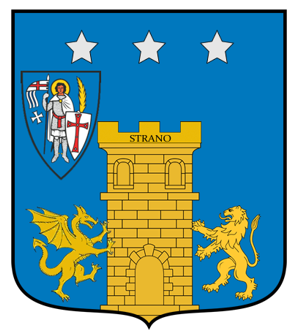
Original registered Strano Family Logo
Strano Family Logo
01 / Family history

Early Origins of the Strano Family

The Strano family is associated with Sicily and, in particular, with Messina. Historical accounts describe the family as an ancient Sicilian family and suggest an association with the Trano da Messina family, which is said to have borne a related heraldic design. The precise nature of this relationship, and the historical reason for variations in the surname, cannot be established from the references cited here. One account proposes that changes in family names may at times have been used to avoid persecution during the conflicts between the Guelphs and the Ghibellines.

The surname is historically associated with Messina (Sicilian: Missina; Latin: Messana), on the north-eastern coast of Sicily. The city's history reaches back to antiquity. It was taken by the Saracens in 831 and by the Normans in 1061. Messina hosted crusaders in 1190. Giuseppe Garibaldi landed in Sicily in 1860 during the campaign that led to the unification of Italy; Messina subsequently became part of the unified Italian state. Medieval records often concentrated on people holding public, ecclesiastical, military, artistic or landowning positions. A family's appearance in such records may be historically significant, but it must be assessed against the original documents before conclusions about ancestry or social status can be drawn.

The family tradition presented on this website places the formation and historical roots of the Strano surname in Sicily. A proposed linguistic explanation connects the form of the name with the Old French word estrange, meaning “stranger” or “newcomer”, and with the medieval Latin form extraneus. This is an etymological proposal, not proof that the family itself originated in France or Normandy. The historical development of a surname in Sicily and the possible linguistic history of a word are separate questions.

After the Norman Conquest of England in 1066, Norman French became influential in the language of the English royal court, administration and aristocracy. William, Duke of Normandy, became William I of England, known as William the Conqueror. This provides a wider historical context for the influence of Norman French and Old French on Britain; it does not, by itself, establish a direct connection between William I and the Strano family.

02 / The family name

Trano & Strano Spelling Variations

Historical accounts list several forms associated with the family name. These include:

StranoUstranuTranoTrainaTrainoTrana

Other forms mentioned in surname accounts include Strainge, Lestrange, Estrange, Stranger, Sraneo and Strani. Similarity in spelling does not necessarily demonstrate that different families share the same ancestry; each proposed connection requires documentary evidence.

Authors cited in historical discussions of Sicilian families and heraldry include Minutoli, Inveges and Mugnos. Their material was also collected or discussed by Palizzolo Gravina in Il Blasone in Sicilia, a heraldic collection printed in Palermo between 1871 and 1875. Accounts attributed to Galluppi refer to the historical nobility of Messina and include works published in the nineteenth century, among them Stato presente della nobiltà messinese (1881) and Nobile della città di Messina (1878). These are historical references; their statements should be read in the context of the period and checked against the original publications.

04 / Historical and legal context

Heraldry, Italy and the Republic

For centuries, heraldic authorities in the Italian states and later in the Kingdom of Italy dealt with matters concerning noble titles, family arms and public honours. The Consulta Araldica was established by royal decree in 1869 to advise the government on such matters.

Following the referendum of 2 June 1946, Italy became a republic. The Constitution of the Italian Republic entered into force on 1 January 1948. Article XIV of its Transitional and Final Provisions states that titles of nobility are not recognised. It also provides for the suppression of the Consulta Araldica. The Italian Central State Archives records that the Consulta's activities effectively ceased in 1944, while a residual office continued to deal with outstanding matters until 1959.

This constitutional position means that the former Italian state system for recognising noble titles no longer operates as it did under the monarchy. It does not mean that historical heraldry, family research, archival study or the private use of family emblems has disappeared or is generally prohibited. Nor does it prevent a family from identifying and protecting an original graphic work as a logo under applicable copyright law.

For these reasons, this website uses the name Strano Family Logo for the family's artwork. It is presented as a family identity and a copyrighted design, not as a claim to a newly granted Italian noble title or official heraldic recognition by the Italian Republic.

The UK Copyright Service registration records the submitted artwork for copyright purposes. It should not be interpreted as a grant of nobility, proof of genealogical descent or an official heraldic grant.
05 / Further reading

Historical references